Game Changer: Volvo Penta's Sterndrive Turns 50
Too radical for some when it first appeared in 1949, sterndrive propulsion has become a mainstay of the recreational marine market.
Ken Olson, president, chairman and founder of Digital Equipment Corp., famously—or infamously—said in 1977, “There is no reason anyone would want a computer in their home.” Evidently, his ability to foresee the personal computer industry was as good as his mastery of English grammar.
The history of the stern drive propulsion system is as controversial as Olson’s declarative statement from just more than a quarter century ago, and it also reinforces the caveat that American captains of industry shouldn’t dismiss new ideas.
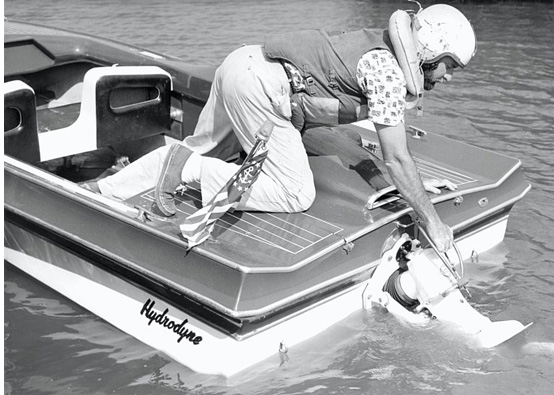
American engineer Jim Wynne in early testing phases of the Aquamatic.
As the story goes, the stern drive first took shape at Massachusetts Institute of Technology in 1948 where a young graduate student in engineering named Charlie Strang began noodling with the idea of putting a car engine in a boat, and rather than using a fixed shaft like an inboard, he wanted to use a trimmable outboard-like drive.
That noodling became doodling, and when Strang went to work for Kiekhaefer Marine, he shared is idea the famously mercurial Carl Kiekhaefer, who reputedly deemed it a “horses*#t idea,” adding that if he turned the engine on its rear and mounted it on an outboard lower gear case, then he’d have something.
While he was at Kiekhaefer Marine, which would later become Mercury Marine, Strang met Jim Wynne, the engineer credited with inventing the stern drive. Long, convoluted story short, after much finger pointing, clandestine activity and other assorted cloak-and-dagger stuff, Wynne filed the paperwork for a patent and presented the concept to Harald Wiklund, then president of Volvo-Penta.
Unlike Kiekhaefer, Wiklund loved the concept and struck a deal with Wynne. However, because Wynne was not really the original inventor of the stern drive, he had to bring Strang back into the picture to explain some of the more intricate details to the engineers at Volvo Penta. Because Strang had been offered the job as president of Kiekhaefer Marine, he didn’t want to leave, and told Wynne, “Jim, do what you want with it.”
When the “Aquamatic” stern drive debuted at the 1959 New York Boat Show, it was undeniably a PR hit, but only managed to sell 3,000 of the initial production run of 10,000 units by the end of 1959. However, when Coronet boats began to offer models already rigged with Aquamatics and a year of interest-free financing, sales began to take off (back in those days, manufacturers sent boats to the dealer, who would then rig the boat with an engine). The Aquamatic also benefited as fiberglass-reinforced plastic began to replace wood as a boat-building material. By 1961, Kiekhaefer lamented and told his distributors that his company would develop its own stern drive for production. OMC also had begun to work on its on model. Since that time, the game-changing stern drive design has become a mainstay in the recreational marine market.
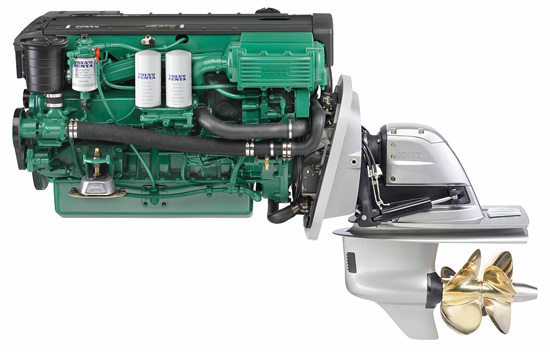
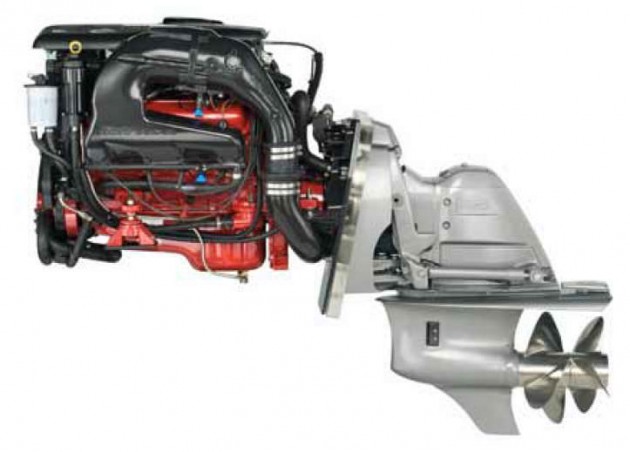
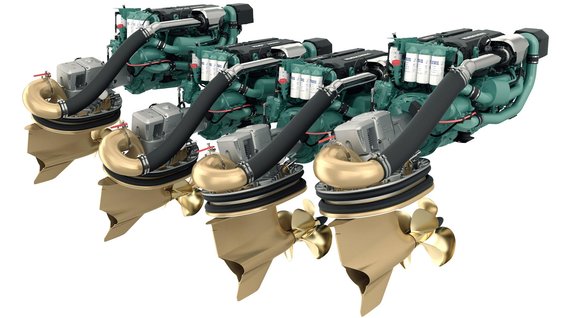
The modern version of Aquamatic – Volvo Penta’s state-of-the-art DPH stern drive with D6-370.
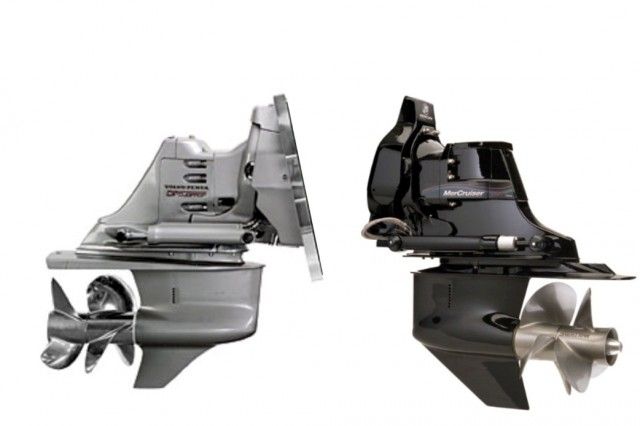
Over the last half century, Volvo Penta has continued development of the Aquamatic, adding diesel power options to its lineup in 1977. In 1982, Volvo Penta debuted the DuoProp drive, which offers greater bite, enhanced tracking and maneuverability, and improved steering. And most recently, Volvo Penta launched a line of composite stern drives specifically for saltwater use.
Over the last 50 years, the Aquamatic sure has come a long way from the humble line drawings of an M.I.T. grad student—and it’s as obvious as the personal computer industry is large that the Aquamatic was anything but a “horses*#t idea.”
Editor’s Note: Brett Becker is a freelance writer based in Ventura, CA. He covers the marine, automotive and racing industries for various print and Web titles.